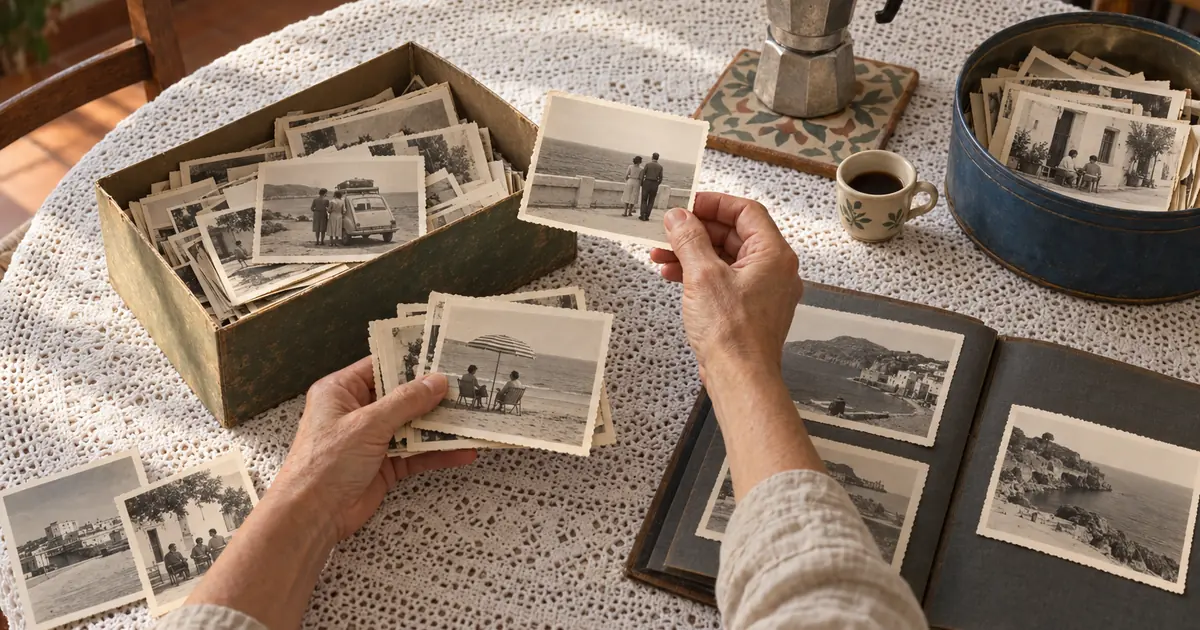
This article was prepared by the Kinmory team, which owns Honrar. We share practical advice for a family archive and explain how our service can help preserve memories.
Introduction
A family archive in Spain can begin with a single album, a few notes and an unhurried conversation. You do not need to know every date or the full biography of each ancestor. It is enough to explain who appears in a photograph and why that moment mattered.
If you have recently lost someone close to you, looking at photographs can be hard. Choose a small task and stop whenever you need to. Our guide on how to cope with grief also lists sources of support. The archive can just as well be organised without a recent loss, to go through your grandparents' albums.
This guide is for families living in Spain and for relatives in other cities or countries. You will see what to keep, how to digitise photographs and how to agree who can see each item.
What to keep in a family archive
Keep each item together with its explanation: names, approximate dates, places, family relationships and where each detail comes from. A small, well-labelled family photo archive is more useful than several boxes of unidentified pictures. Mark which information is confirmed and which still needs checking with another relative or a document.
| What to keep | How to do it | What it gives the family |
|---|---|---|
| Photographs and their backs | Copy both sides, note names, place and date | Recognising the people and the occasion |
| Conversations with older relatives | Record them with permission, note the speaker and the date | Their voice and first-hand explanations |
| Letters, postcards and diaries | Keep the originals, make copies and set aside private material | The person's own words |
| Family papers | Photograph the Libro de Familia, memorial cards and death notices | Names and dates to check family accounts |
| Names and relationships | Draw a diagram on paper with sources and doubts | The link between generations |
| Recipes, songs and household customs | Write down who shared them and on what occasion | The character and everyday life of your family |
| Archive index | Note folders, numbers and storage places | Someone else can find what they need |
Write household nicknames next to the official name: the 'Aunt Pili' of long family lunches may appear as Pilar in documents. Prepare the selection you plan to share separately, without addresses, phone numbers, medical details or images of children. If a relative prefers not to talk about a period of their life, the archive can do without that part.
Six steps to gather the family archive
Keep the albums in their existing order, write down what you already know, make copies and agree who has access to them. Always note the source of each detail. Permission to record a conversation and permission to share it are two separate agreements. You do not need to go through the whole archive at once: one album and one conversation are enough to begin.
1. Choose one album or box
Photograph the album before touching anything: the order of the pages shows which pictures belong to the same trip or celebration. Number the images, for example 'album-A, photo-01'. Do not peel off glued photographs or flatten fragile pages yourself. For damaged material, ask a conservation professional.
2. Ask about specific things
Prepare a few questions: who is in the photograph, where the house was, what each person did for a living, what was cooked for celebrations. Ask whether you may record the conversation and who will be able to listen to it. Do not insist if someone prefers to stay silent. Repeat unfamiliar names to check that you have understood them.
3. Note who appears, where and when
Write the names from left to right, then the place, the occasion and the date. If you are unsure, put 'about 1965' or 'according to Aunt Pilar' instead of inventing a date. Do not write on the photograph with a pen: keep the explanations in a separate list, with the same number as the image.
4. Digitising old photographs on both sides
Flat photographs in good condition can be scanned. If you have no scanner, photograph them with your phone held parallel to the print, in even light, without reflections or shadows from your hands. Copy the whole image with its edges and the back as well, even if it only carries a date or a studio stamp.
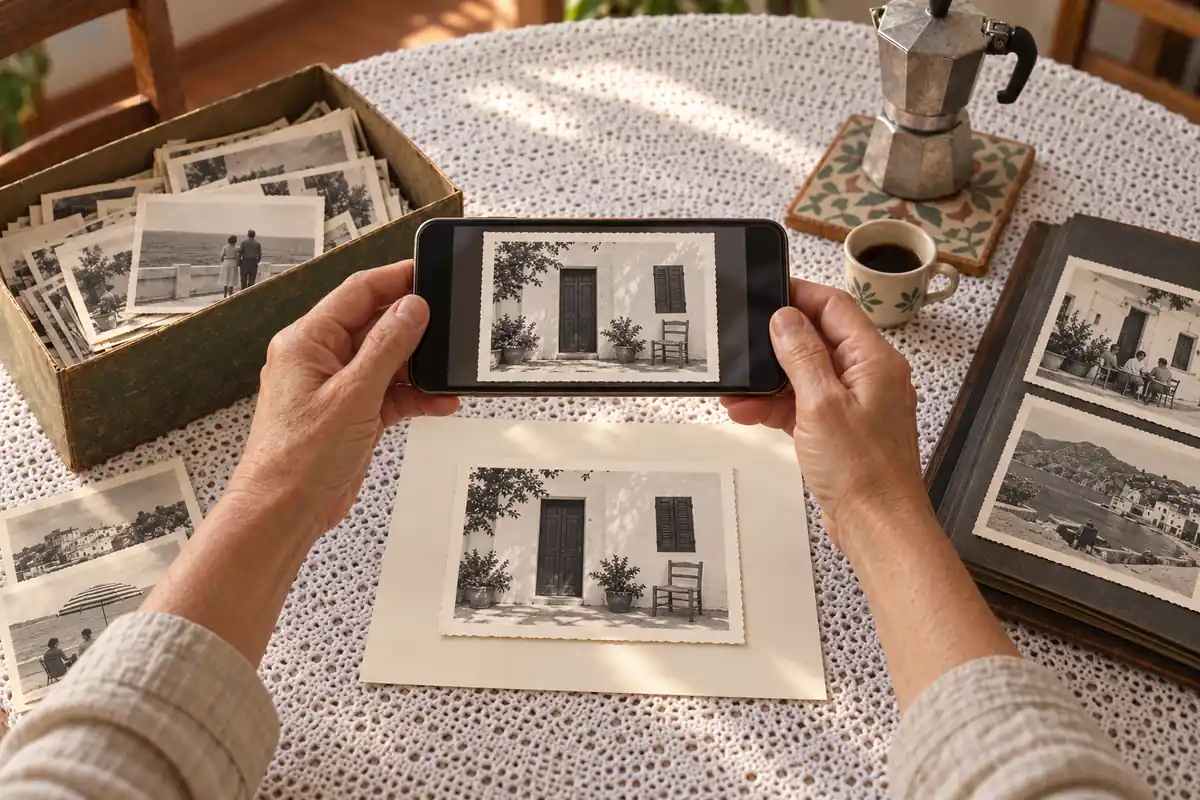
Enlarge the copy to check small faces and handwriting. Keep the first file uncropped and save edited versions separately. Label any automatic restoration as such: reconstructed details do not show what the person really looked like.
5. Write a short account and draw the tree on paper
Bring together in a short text what the photographs and conversations tell you: where the person was born, what work they did, which places mattered to them. Our guide on how to write an obituary can help you sum up a life story in a few lines. For the tree, start with yourself on a sheet of paper, add your parents and earlier generations, and mark the details still to be checked.
6. Make a second copy and check that it works
Decide who keeps the originals, who holds the second copy and who adds the notes. Before sharing anything, ask permission from the living people the material concerns. Then ask another relative to find a photograph by the person's name: you will see which explanations are missing.
Names, papers and the home village: a family archive in Spain
In Spain, the two surnames, the different forms of the same first name and some household papers, such as the Libro de Familia, help you identify each person. Gatherings in the family's home village and relatives living elsewhere add memories and photographs that are not in your house.
Two surnames and several forms of one name
Spain's Civil Registry Act states that parentage determines surnames and that parents agree the order in which each passes on their first surname (Law 20/2011, Article 49). Always record both surnames: you will tell apart two cousins with the same name and follow each branch.
The same law allows a first name to be replaced by its equivalent in any of Spain's languages (Article 50). This is why one person may appear as José in one document and as Josep or Xosé in another. Keep all the forms together, with their source, and do not correct the family history on a guess. If your family also uses English names, note those versions alongside.
The Libro de Familia and other household papers
New Libros de Familia (family record books) were phased out as each civil registry office adopted the DICIREG system, under the Instruction of 16 September 2021, section 10.3. Previously issued books remain valid (Law 20/2011, third transitional provision). If there is one at home, photograph its pages: its entries for marriages, children and dates help put names to many photographs.
Keep memorial cards (recordatorios) and death notices (esquelas) as well. Whether there was a burial or a cremation, keep a copy of the documents from the cemetery or the funeral director. They may include the título de derecho funerario for a niche or a grave, whose conditions are set by each town council or cemetery. In Madrid's municipal cemeteries, for example, the regulations ask the holder to keep the title and report its loss (Article 16). For niches, graves and columbaria, see the types of burial plots in Spain.
Returning to the village and family living elsewhere
Many Spanish families gather in their home village in summer, at local fiestas or around All Saints' Day. These are good moments to show a few printed photographs and ask questions calmly: the person who recognises a house is often not the one who keeps the album.
Relatives in other cities or countries may have copies nobody else has seen. Ask them for the files at their original size, not the thumbnail from a chat. If they write in another language, keep their text with the translation and note who translated it.
Where to keep the archive and who can see it
Keep the materials in two independent places and add an index to each copy. Combine a format that is easy to browse together, such as a printed album or a memorial page, with a folder of original files. Check from time to time that the files open and that another relative knows how to find them.
| Format | Who has access | Useful for | How to look after it |
|---|---|---|---|
| Paper album | The family and visitors | Looking at photographs together and reading captions | Digitise the photographs and keep it somewhere dry, out of the sun |
| Files on a home device | The keeper and those who receive copies | Original photographs, recordings and documents | Make a second copy on another device |
| Shared cloud folder | People with permission | Collecting contributions from relatives in different cities | Agree folder names, permissions and a separate copy |
| Printed album for relatives | Those who receive a copy | Giving an explained selection | Keep the files used for printing |
| Memorial page | Visitors according to the chosen access mode | Bringing together photographs, a life story and memories from loved ones | Keep the original materials and agree access with the family |
For the second copy, choose another device or leave it with a trusted relative. Add a document called 'How to use the archive' with the numbering, the private materials and the person responsible. Do not store passwords in a folder the whole family can see.
Your own story: what to prepare for your family
Choose a few photographs, explain some important moments and tell your loved ones where the copies are. A few notes about childhood, work, the village or a recipe are useful too. Add captions to recent photographs: what seems obvious today will not be obvious to the next generation.
Before publishing photographs or letters of a relative who has died, talk to the closest family. Protecting the honour, privacy and image of a person who has died falls to whoever they named in their will and, failing that, to the spouse, descendants, ascendants such as parents and grandparents, and siblings who were alive at the time of death (Organic Law 1/1982, Article 4). The same law treats publishing private letters, memoirs or other personal writings without consent as an unlawful intrusion (Article 7). If there is no agreement, keep the material in the private archive.
Think about your own photographs and online accounts too. Spain's data protection law allows relatives and heirs to ask online services for access to the content of a person who has died, unless that person expressly forbade it. Regions with their own civil law, such as Catalonia, apply their own rules (Organic Law 3/2018, Article 96). Write down who should deal with this and, to give it legal effect, consult a notary.
How Kinmory can help
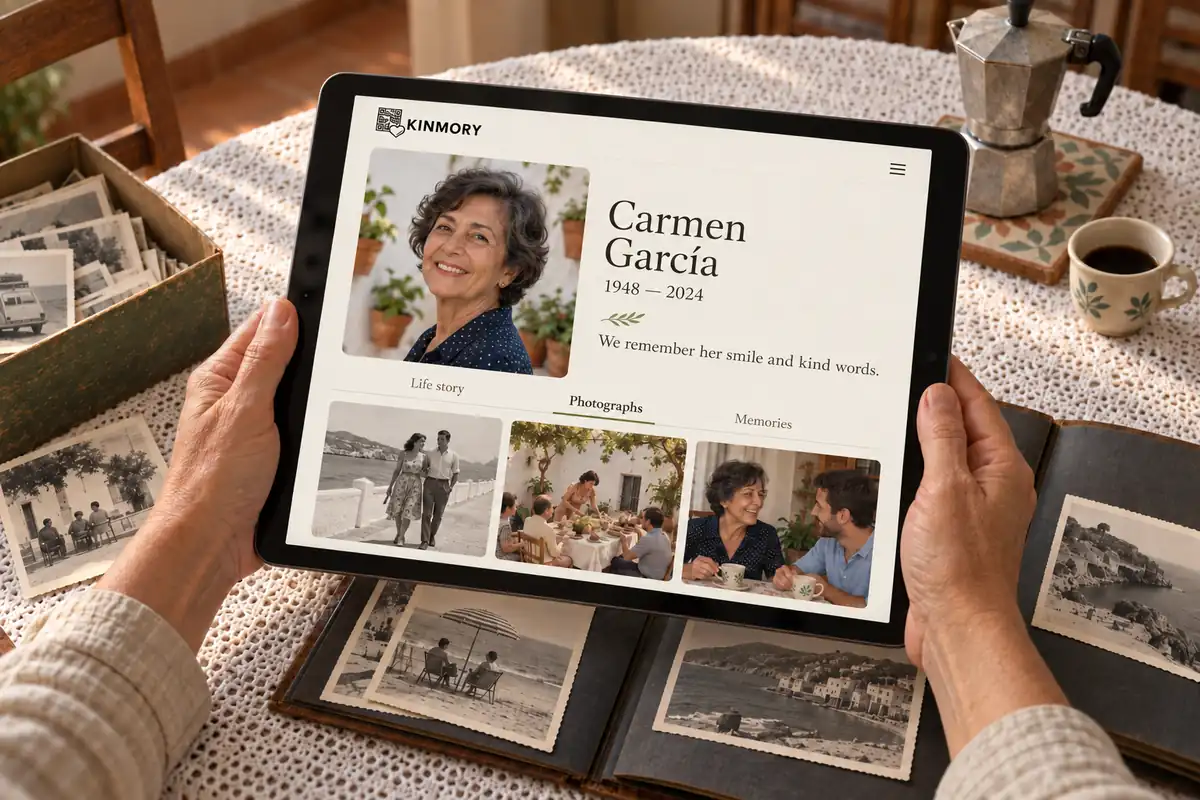
Kinmory lets you create a memorial page for a loved one with their portrait, photographs and life story, and share it with your family. A QR code can link it to a plaque beside the niche or headstone. You can explore its features on the service's home page.
In future we plan to add to Kinmory the option to keep your own memorial page, create photo albums and family trees, and write memoirs. This will make it possible to bring memories of loved ones and your own story together in one place.
Portrait, photographs and life story
In Kinmory you can bring together your loved one's portrait, captioned photographs and life story on a single page. Start with a few photographs and one memory: a journey, a trade, Sunday lunch. Choose a design that suits the way you remember the person and add your own words. Before publishing, you can preview how the page looks.
The guest book lets relatives and friends leave their memories and words of support. When creating the page you can keep it switched on, or switch it off if you prefer to show only the account prepared by the family.
Access and family participation
You decide who you share memories with: a public page, a password-protected page or one reserved for invited people. Search engines may find a public page. Public and password-protected pages go through moderation before visitors can see them, and the review is repeated after editing or switching to those modes. The link and QR code work for visitors once that review is complete.
After publishing, you can invite relatives by email or with a link. For closed viewing and editing, each invited person uses their own account. Building the page together depends on the chosen plan. The page remains with the person who created it, and an accepted invitation stays valid, so it is best to invite people you trust.
QR code and original materials
After publishing, you can download the page's QR code as an image and use it to prepare a plaque. You can ask the Kinmory team about production, ordering and delivery options. Before fixing it in place, ask the cemetery what is permitted on the niche or headstone, test the code with a phone and keep the same page address.
The page is created without a set expiry date and can be added to over time. Keep the original photographs and texts in your family archive as well, in two independent places. Adding video depends on the plan. You can prepare and preview the page before payment, which is made when you publish it.
Explore Kinmory's options and choose the photographs and memories that will begin your loved one's page.
Frequently asked questions
Where do I start if I have a lot of loose photographs?
Choose a single box or envelope. Photograph how the pictures are arranged before moving them, number them and note who appears in a few of them with a relative's help. Leave the originals where they are and make a second copy of the images and their explanations. Then move on to the next box at your own pace.
How should I record a name or a date I am not sure about?
Write 'about', 'perhaps' or 'according to…' and say where the information comes from. Keep the different forms of a name together, for example José and Josep, along with both surnames of each person. If accounts differ, note them separately until a document or a relative helps to clarify the detail.
Can I publish photographs and letters of a relative who has died?
Before publishing them, talk to the closest relatives. In Spain, protecting the honour, privacy and image of a person who has died falls to whoever they named in their will and, failing that, to their spouse, descendants, ascendants and siblings. Private letters also require the consent of the people concerned. If there is no agreement, keep them in the private archive.
Who can see a page created with Kinmory?
In Kinmory you choose a public page, password access or closed viewing for invited people with their own accounts. Public and password-protected pages go through moderation, which is repeated after editing or switching to those modes. The link and QR code work for visitors once the review is complete. Search engines may find a public page.
How should I keep the materials used on a memorial page?
A Kinmory page is created without a set expiry date and can be added to with photographs and memories. Also keep the original photographs, captions and texts in your family archive, in two independent places. These copies will help you print an album, prepare a family chronicle or share memories with grandchildren.
Summary
Choose three manageable steps: caption a few photographs, record one story with the speaker's permission and make a second copy of the materials. Check that the copy opens and tell a trusted relative where the originals and notes are kept. Then carry on adding to the archive at your family's pace, with no obligation to fill every gap or publish what you have gathered.
Sources
- Law 20/2011 on the Civil Registry — surnames, first names in Spain's languages and family record books.
- Instruction of 16 September 2021, section 10.3 — the phase-out of family record books as each office adopted DICIREG. This point was checked on 22 October 2026.
- Organic Law 1/1982 — honour, privacy and image of a person who has died.
- Organic Law 3/2018 — digital content of people who have died.
- Madrid regulations on funeral services and cemeteries (BOCM of 14 June 2016) — keeping the title.
Sources consulted on 21 October 2026. Information about Kinmory's features was provided by the service's team, which runs Honrar. Current design options and ordering conditions are available on the Kinmory website or from our team.